

Last Updated: November 14, 2026
Quick Summary
To keep motorcycle electronics charged while camping off grid, first calculate your daily watt-hour demand, then size a power bank, bike USB outlet or solar panel to cover it with a 20 percent loss margin. Use a fused USB outlet on the bike for riding top-ups and carry a backup power bank.
- Convert device batteries to watt-hours by multiplying mAh by 3.7 and dividing by 1,000.
- A three-day example trip in the article needs about 269 Wh of usable capacity after a 20 percent margin.
- Install an inline fuse close to the battery when wiring a motorcycle USB charger.
- Real solar output at a campsite often runs only 25 to 70 percent of a panel’s rated wattage.
- Use a battery tender to keep the bike battery charged while it sits between trips.
Table of Contents
- Working Out How Much Power Your Trip Needs
- Installing a Motorcycle USB Charger Safely
- Choosing a Portable Power Bank for Motorcycle Camping
- Using a Solar Charger for Motorcycle Camping: Realistic Expectations
- Protecting Your Bike Battery with a Motorcycle Battery Tender
- Sample Setups for Weekend, Week-Long and Multi-Week Trips
- Planning Your Power Setup Before the Next Ride
- Frequently Asked Questions
Working Out How Much Power Your Trip Needs
Off-grid camping drains a motorcycle electronics charged setup faster than most riders expect, so plan power before you leave. Phones, GPS units, helmet intercoms, action cameras and lights all draw from a limited supply. The fix is not to buy the biggest battery you can find; it is to estimate your daily watt-hour demand first, then size the battery and solar panel to match. For a broader look at preparing the bike itself for long trips, see long-distance preparation guidance.
Converting mAh to watt-hours
Most small device batteries are rated at 3.7 volts nominal. To convert, multiply the mAh rating by 3.7 and divide by 1,000. A 4,000 mAh phone battery is therefore about 14.8 Wh. A 1,500 mAh action-camera battery is about 5.6 Wh. A 2,000 mAh intercom battery is about 7.4 Wh. Power banks are usually rated at the same 3.7 volts internally, so a 20,000 mAh bank holds roughly 74 Wh before conversion losses.
A worked power-budget worksheet
Use this table before you leave home. The example is a three-day trip with one rider carrying a phone, a GPS unit, a helmet intercom, two action-camera batteries and a small camp light. For the complete list of riding gear to pack alongside your power setup, see long-distance riding gear.
| Device | Battery size | Wh per full charge | Charges per day | Daily Wh |
|---|---|---|---|---|
| Phone | 4,000 mAh | 14.8 | 1.5 | 22.2 |
| GPS unit | 2,000 mAh | 7.4 | 1 | 7.4 |
| Helmet intercom | 2,000 mAh | 7.4 | 1 | 7.4 |
| Action camera (2 batteries) | 1,500 mAh each | 11.1 | 2 | 22.2 |
| Camp light | 3,000 mAh | 11.1 | 0.5 | 5.6 |
| Daily total | 74.8 Wh |
Charges per day
Multiply the daily total by trip days: 74.8 Wh x 3 days = 224.4 Wh. Then add a charging-loss margin. Cables, conversion circuitry and heat typically waste 15 to 25 percent of the energy you put into a bank or device, so add 20 percent: 224.4 x 1.2 = about 269 Wh of usable capacity needed for the trip.
Sizing a battery from the worksheet
A 20,000 mAh power bank at 3.7 volts holds about 74 Wh nominal, and after its own conversion losses you can realistically pull 55 to 65 Wh out of it. That covers less than one full day of the example trip. Two such banks cover roughly two days, which is why the weekend setup in this guide pairs a bank with a bike USB outlet for riding top-ups. If you want a single battery to cover the whole three-day trip without riding charging, look for a portable power station rated around 300 Wh, which leaves headroom for cold-weather capacity loss and the occasional extra charge. For a smaller setup built around riding top-ups, choose a power bank by matching its usable capacity to the devices you need to keep charged.
Sizing solar from the same number
A solar panel’s rated wattage is measured under full sun at a favorable angle. To replace 74.8 Wh per day, a 60-watt panel would need about 1.25 hours of true rated output, but campsite conditions rarely deliver that.
Watch out: if your worksheet total exceeds what your battery and panel can realistically deliver, the shortfall shows up as a dead phone or a dead bike battery on the last day, not as a warning.
Installing a Motorcycle USB Charger Safely
A motorcycle USB charger lets you top up devices while you ride. Most riders wire a USB outlet to the bike’s battery or a fused accessory circuit.
Watch out: connecting a charger directly to the battery terminals without a fuse can cause a short circuit and start a fire.
Follow these basic steps:
- Choose a charger rated for your bike’s electrical system, usually 12 volts.
- Mount the outlet where it stays dry and out of the way of your knees.
- Run the wire through a grommet and secure it away from moving parts.
- Connect the positive wire through an inline fuse, then to the switched accessory circuit.
- Test the outlet with a multimeter before your first long ride.
If you are not comfortable with electrical work, a motorcycle shop can do the install in an hour or two.
Choosing a Portable Power Bank for Motorcycle Camping
A portable power bank is the simplest option for camp charging. You charge it at home or while riding, then carry it to camp. Many riders keep one as a backup even when they have a bike outlet.
Look for these features when you shop:
- Capacity: Measured in mAh. Larger banks hold more charge but weigh more.
- Output: Check for USB-C Power Delivery if your phone supports fast charging.
- Ruggedness: Water resistance and a sturdy case matter when gear gets rain or dust.
Compare any power bank against your worksheet total. A bank with 20,000 mAh can cover several phone charges, but it may not cover a whole week of devices.
Using a Solar Charger for Motorcycle Camping: Realistic Expectations
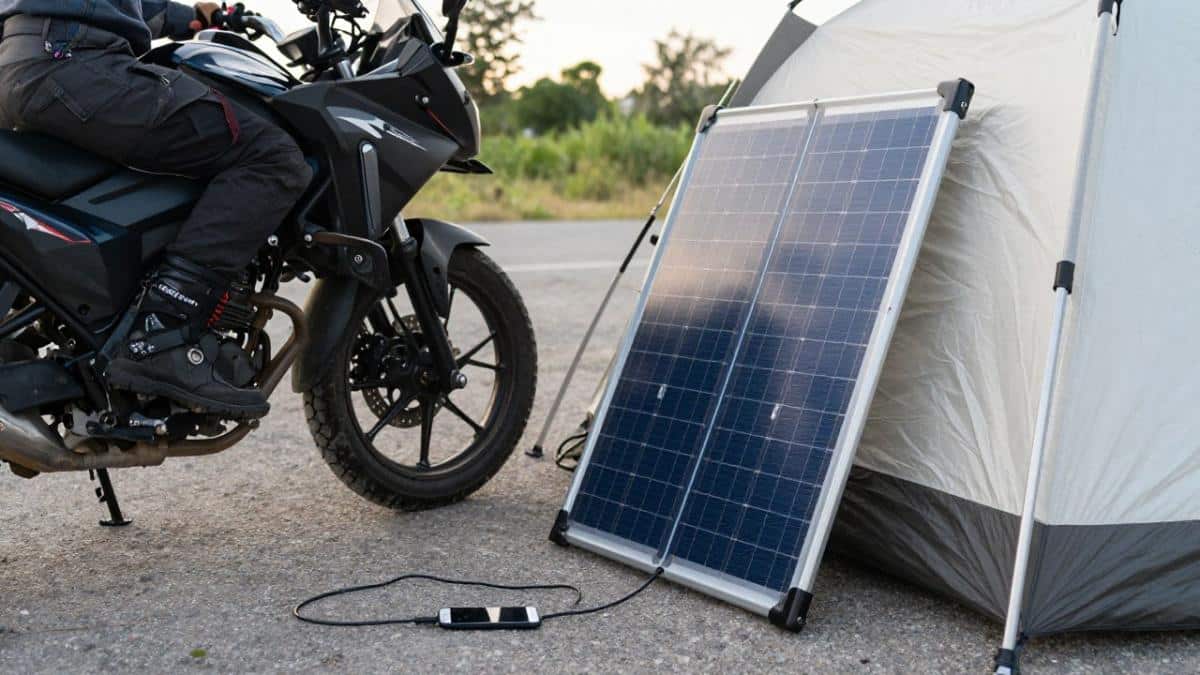
Solar panels appeal to riders who want to stay off grid for long stretches. They work, but the gap between a panel’s rated wattage and what it actually delivers at a campsite is larger than most buyers expect. Understanding that gap is what separates a solar setup that keeps devices alive from one that leaves you hunting for an outlet in town.
Rated output versus campsite output
A panel’s wattage is measured under standard test conditions: full sun, a fixed angle perpendicular to the sun, and a cell temperature of about 77 degrees Fahrenheit. A campsite rarely matches that. Expect these common losses:
- Sun angle: A panel lying flat on a table or pannier collects far less than one tilted toward the sun. Tilting can recover a large share of the loss, but only if you reposition the panel through the day.
- Shade: Even partial shade on one cell can cut a panel’s output disproportionately, because cells are wired in series. A tree branch across a corner is worse than the shaded area suggests.
- Cloud and haze: Thin overcast can drop output by half or more, and heavy cloud can drop it to a small fraction of rated power.
A common planning rule among off-grid users is to expect 50 to 70 percent of rated output on a good day with active repositioning, and 25 to 40 percent on a marginal day. A 60-watt panel therefore yields roughly 30 to 42 watts of real charging on a good day and 15 to 24 watts on a poor one.
What that means in watt-hours
Multiply real charging watts by usable sun hours. In summer at mid-latitudes, a well-placed panel might see four to six equivalent full-sun hours; in spring or fall, three to four; in winter or under forest canopy, one to two. A 60-watt panel at 35 real watts over four hours returns about 140 Wh, which covers a typical rider’s daily device load with margin.
When solar is the wrong tool
Solar is a poor primary source when any of these apply:
- You ride most of the day and only stop after dark, so the panel never sees direct sun.
- Your campsite is under dense canopy or in a canyon with a short sun window.
- Your daily need exceeds roughly 150 Wh and you are not carrying a large, heavy panel.
In those cases, treat solar as a supplement to a power bank or bike outlet rather than the main source, and plan town stops to recharge.
Charge controllers and panel matching
A charge controller sits between the panel and the battery and prevents overcharging. Match the controller to the panel’s voltage and current, and match the panel to the battery chemistry you are charging.
Watch out: a panel left connected to a battery in changing sun can overcharge it if the controller fails or is missing, so never rely on panel size alone to protect the battery.
Protecting Your Bike Battery with a Motorcycle Battery Tender
If you run accessories off the bike battery while camped, the battery can drain before you ride again.
Connect the tender to the battery with the clamps, then plug it into a wall outlet or a solar panel sized for it.
Be careful not to leave a tender connected to a damaged battery. Check the battery for swelling or leaks before connecting anything.
Sample Setups for Weekend, Week-Long and Multi-Week Trips
Your setup should match the length of your trip. Here are three examples to adapt:
- Weekend trip (2 to 3 days): One 20,000 mAh power bank, a bike USB outlet for riding, and a small charging cable kit.
- Week-long trip (5 to 7 days): A bike USB outlet, two power banks, and a 60-watt solar panel with a charge controller for camp top-ups.
- Multi-week trip (14 days or more): A bike USB outlet, a battery tender, a portable power station, and a solar panel. Carry spare cables and a backup bank.
Many riders find the week-long setup covers most needs. Longer trips depend heavily on sunny days and access to a town where you can restock. For practical advice on what to bring and how to camp at rallies, see rally camping tips.
Planning Your Power Setup Before the Next Ride
Good planning makes camping off grid far more relaxed. Use your power-budget worksheet, pick a primary charging source, and carry one backup. Test every device and cable at home before you leave.
A well-planned power system makes a week away far easier to enjoy. Riders who share their setups often find the best ones match gear to the trip rather than buying everything at once.
Frequently Asked Questions
Can you charge a phone from a motorcycle battery?
Yes, but only through a properly fused USB charger wired to the battery or through a 12-volt accessory outlet, and only while the engine is running or while the battery is topped up. Drawing power from a parked bike with no charging source drains the battery, which can leave you unable to start the engine the next morning. A dedicated USB charger with a low-voltage cutoff protects the battery. For camping off grid, pair the bike-powered charger with a power bank so you can keep the battery healthy when the engine is off.
How long can you leave a motorcycle battery on trickle charge?
A battery tender is designed to be left connected for weeks or months, because it switches to a float or maintenance mode once the battery reaches full charge. Most quality tenders are safe to leave on indefinitely as long as they are rated for your battery type. Cheap chargers without automatic shutoff can overcharge and damage the battery. Check the charger’s labeling for a maintenance or float mode, and confirm it supports your battery chemistry before connecting it for long storage periods.
Will a portable power bank last for a weekend camping trip?
It depends on the power bank’s capacity and your devices’ consumption. A typical phone battery holds roughly 12 to 15 watt-hours, so a 20,000 mAh power bank (about 74 watt-hours at 3.7 volts) can recharge a phone several times. Add up what you plan to charge each day, including phone, GPS, action camera and headset, and compare that total against the bank’s watt-hour rating after accounting for conversion losses of about 10 to 20 percent. For a weekend, one or two high-capacity banks usually covers a couple of devices.
Can a solar charger keep electronics charged while camping off-grid?
A solar charger can supplement your power, but it rarely covers everything on its own during a multi-day trip. Output depends heavily on panel wattage, sun angle, weather, and whether the panel is mounted on the bike or set up at camp. Under clear skies, a 20-watt folding panel might deliver only part of a phone’s daily needs in practice. Use the solar panel to top up power banks during the day, and rely on the bike’s charging system while riding for the bulk of your power.


0 Comments