
Quick Summary
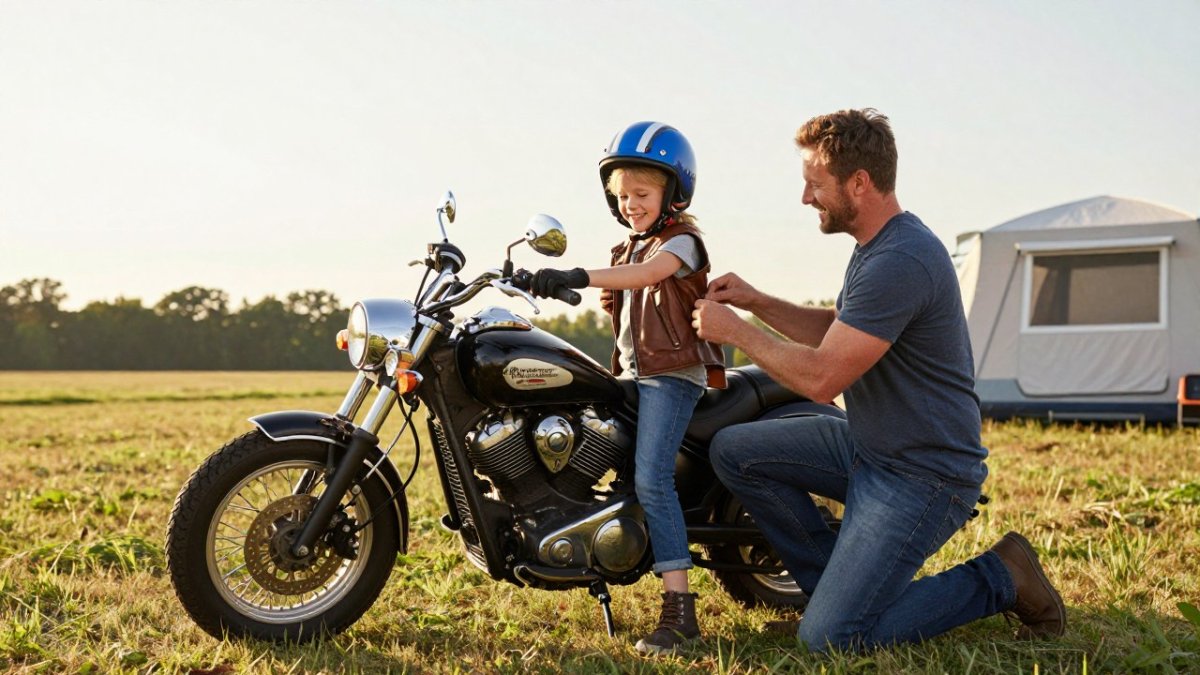
The best motorcycle gear for children passengers is youth-sized and fitted to the child, starting with a helmet that carries a DOT label and a snug fit. Add a jacket with armor pockets, gloves, and over-the-ankle boots, and confirm the child can reach the footpegs and hold on before riding.
- Confirm the helmet has a DOT symbol on the back, since novelty helmets are not for highway use.
- Measure head circumference above the eyebrows and use the manufacturer’s youth sizing chart.
- Choose a youth jacket with abrasion-resistant material, reinforced shoulders, and removable armor.
- Check that the helmet does not rotate when the child shakes their head.
- Verify current state passenger rules, since they vary widely across the United States.
Table of Contents
- Why Children Passengers Need Dedicated Gear
- Kids Motorcycle Helmet Fit: Getting the Right Size
- Youth Motorcycle Jackets With Armor
- Motorcycle Gloves and Boots for Kids
- Minimum Age, Height, and Legal Requirements for Child Passengers
- Motorcycle Passenger Gear Checklist
- Planning Your Family’s Next Ride With Spirit of Indian
- Frequently Asked Questions
Why Children Passengers Need Dedicated Gear
Last Updated: November 21, 2026
Carrying a child on the back of a motorcycle changes the risk picture in a few important ways. A child passenger has less control over the bike, less experience reading traffic, and a body that is still developing. That is why the best motorcycle gear for children passengers is not simply a smaller version of adult gear.
Adult gear often sits poorly on a child. Oversized jackets flap in the wind, loose helmets shift on impact, and gloves that slip off make it hard for a child to hold the passenger handholds. Gear designed for youth sizes addresses these problems directly.
Treating the child’s kit as a complete system rather than a single purchase is a sensible approach. Start with a helmet that fits, then add a jacket, gloves, and footwear that cover the body from head to ankle.
Kids Motorcycle Helmet Fit: Getting the Right Size
A properly fitted helmet is the most important piece of the best motorcycle gear for children passengers, and fit is only half the job. The other half is confirming the helmet is actually certified for on-road use. A snug, comfortable helmet that lacks a proper certification label offers little real protection.
Check the certification label first
In the United States, on-road motorcycle helmets are required to meet Federal Motor Vehicle Safety Standard (FMVSS) No. 218, administered by the National Highway Traffic Safety Administration (NHTSA). Compliant helmets carry the DOT symbol on the back. Many quality helmets also carry a Snell Memorial Foundation certification, which is a voluntary standard with its own testing protocol (Snell helmets certification).
Look for the DOT label on the rear of the helmet and, where present, the Snell sticker inside. If a helmet has no DOT marking, treat it as decorative, not protective.
Watch out: novelty helmets and helmets sold only as fashion accessories are widely available and can be mistaken for real motorcycle helmets, so verify the label before you buy rather than after.
Measure and fit step by step
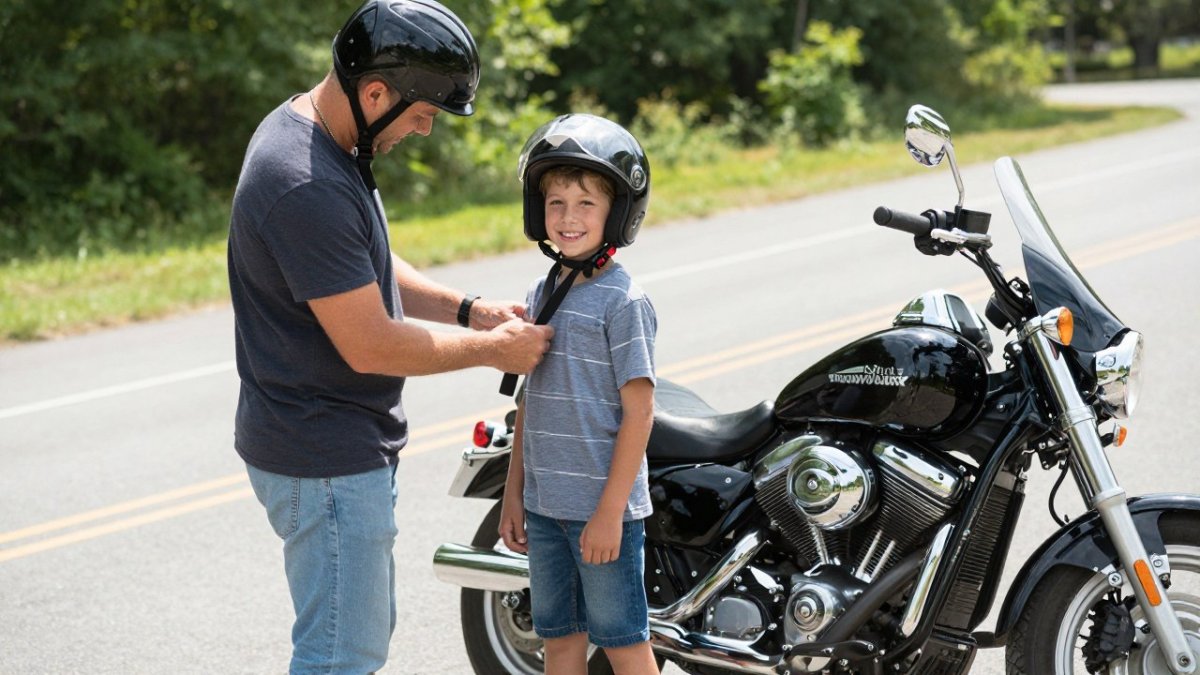
Measure the child’s head circumference just above the eyebrows and compare it to the manufacturer’s youth sizing chart. Youth helmets are sized separately from adult helmets, so do not assume a child’s adult-small will work.
Once the helmet is on, check four things:
- The helmet sits level and snugly without pressure points on the forehead or crown.
- The cheek pads press lightly against the cheeks without pinching.
- The chin strap is fastened with no more than a finger’s width of space underneath.
- The helmet does not rotate or slide when the child shakes their head or when you gently try to roll it forward and back.
A full-face or modular helmet offers more coverage than an open-face helmet, and a face shield protects the eyes from wind and debris. For a child passenger, the extra coverage is usually worth the added weight.
What to do when a child is between sizes
A common pattern is for parents to buy the larger size so the child can grow into it. That is the wrong trade-off for a helmet. An oversized helmet can shift on impact and can rotate forward over the eyes during a ride. If a child falls between two sizes, choose the smaller size only if it passes the roll-off and pressure-point checks above; otherwise, look for a different model or brand whose shape matches the child’s head better.
Replace a helmet that no longer fits well, and check the fit again before every season. A helmet that has been dropped hard or involved in a crash should be replaced even if it looks intact.
The helmet fit checks and certification points covered in this section can be scanned at a glance.
| Check | What to look for | Note |
|---|---|---|
| Certification | DOT symbol on the back | Novelty helmets are not for highway use |
| Snell certification | Snell sticker inside the helmet | Voluntary standard, where present |
| Chin strap | No more than a finger’s width of space | Fastened securely |
| Rotation test | Helmet does not slide when the head shakes | Confirms a snug fit |
| Between sizes | Choose the smaller size only if it passes the checks | Oversized helmets can shift on impact |
| Replacement | Replace after a hard drop or crash | Even if the helmet looks intact |
Youth Motorcycle Jackets With Armor
A riding jacket protects against abrasion in a fall and against wind and weather on a long ride. Look for a youth jacket made from leather or a high-abrasion textile, with reinforced shoulders and elbows. Armor pockets in the shoulders and elbows should accept impact protectors, and those protectors should be removable so they can be replaced as the child grows.
Choose a jacket with a close fit that still allows the child to sit comfortably behind the rider. A jacket that rides up at the back or restricts movement at the shoulders will make the ride uncomfortable. A secure fit is only one part of keeping a young passenger protected, so Saddleworld Devonport can help you consider how the rest of their riding gear works together.
Ventilation matters on warm days. Many riders in hot climates favor mesh panels or zippered vents, which keep a child cooler without sacrificing protection.
Motorcycle Gloves and Boots for Kids
Gloves keep a child’s hands warm, protect the knuckles and palms in a slide, and help the child grip the passenger handholds. Choose gloves with a snug fit at the wrist and fingertips that do not extend past the actual fingers. Gloves that are too large will fold and bunch under the grip.
Footwear should be over-the-ankle boots with a firm sole and a heel that will not catch on the footpegs. Sneakers and sandals do not offer enough protection for a passenger. Boots should grip the ankle and stay in place when the child stands on the pegs or shifts position.
Minimum Age, Height, and Legal Requirements for Child Passengers
Passenger rules are set by state law, and they vary widely across the United States. Some states set a minimum age for motorcycle passengers, while others set requirements based on the child’s height, on whether the child can reach the footpegs and hold the handholds, or on both. A few states have no passenger-specific age rule at all. Because these laws change, verify the current rules with your state’s motor vehicle agency or the state’s official legal code before every trip, and check the rules in any state you plan to ride through.
What the rules typically address
State passenger laws commonly cover three things:
- A minimum age for a passenger, where one exists.
- A requirement that the passenger be able to sit securely and reach the footpegs.
- Helmet requirements, which may apply to all riders, only to minors, or only above a certain age.
Helmet use rules also vary by state. Some states require helmets for all riders, some require them only for riders under a set age, and some have no universal helmet law. For a child passenger, treat a certified helmet as mandatory regardless of what state law requires.
The manufacturer’s passenger rating matters too
Many riders also use the motorcycle’s own guidance. Most manufacturers state whether a passenger seat is designed for carrying another person, and many recommend that a passenger be able to reach the footpegs and hold the handholds throughout the ride. Some bikes are sold as single-seat models or have a rear seat rated for only a limited load. Follow those limits even where state law is more permissive, and check the owner’s manual for the passenger weight limit and any seating restrictions.
A passenger-readiness test before the first ride
Before taking a child on a motorcycle, run through a practical readiness check:
- The child can reach the footpegs with both feet and keep them there without straining.
- The child can hold the handholds or a passenger belt for the full ride.
- The child can sit still and follow simple instructions, such as leaning with the rider through a turn.
- The child is tall enough and strong enough to stay seated without sliding forward under braking.
If a child cannot meet these checks, the child is not ready to ride pillion, regardless of what the state minimum age allows. A short, low-speed test in a parking lot or quiet street is a reasonable way to confirm readiness before any road ride.
Watch out: a child who meets the state age minimum but cannot reach the footpegs or hold on securely is not a safe passenger, so treat the legal minimum as a floor, not a green light.
Motorcycle Passenger Gear Checklist
Use this checklist before every ride with a child passenger:
- Helmet fits snugly, with no rotation when the child shakes their head
- Chin strap fastened with no more than a finger’s width of space
- Jacket fits without flapping and includes abrasion-resistant material
- Armor pockets are filled with protectors sized for the child
- Gloves fit at the wrist and fingertips and allow a firm grip on handholds
- Over-the-ankle boots with a firm sole and a heel that will not catch on the pegs
- Child can reach the footpegs and hold the handholds
- Passenger briefed on leaning with the rider and holding on
- Current state passenger rules checked
Budget matters, but do not compromise on the helmet. A reasonable plan is to spend the most on the helmet, then add a jacket, gloves, and boots as budget allows. Pricing varies widely by brand, material, and retailer, so check current prices with the retailer before buying.
Planning Your Family’s Next Ride With Spirit of Indian
Once the gear is ready, the next step is choosing a place to ride. Spirit of Indian is a motorcycle rally held at River’s Edge Campground in New Richmond, Wisconsin, with curated rides through Wisconsin and Minnesota, live entertainment, and a charity duck race. Families can see the lodging options that include cabins and tiny homes, and we explain how to keep kids comfortable on motorcycles to help plan the trip.
For current ticket details and booking, check the Spirit of Indian 2027 ticket page. For more background on family rides, read our benefits of motorcycle travel for families guide, or compare options in our best motorcycle rallies for families roundup.
Join us at Spirit of Indian and make your family’s next ride a memorable one.
Frequently Asked Questions
Can a 7 year old ride passenger on a motorcycle?
Minimum age and size rules for motorcycle passengers vary by state, so check your state’s motorcycle laws before riding with a young child. Beyond legal limits, a child should be tall enough to reach the passenger footpegs with their feet, able to hold the handholds or the rider securely, and mature enough to sit still and follow instructions. Many experienced riders wait until a child can reliably meet these conditions. Riding with a properly fitted helmet, a armored jacket, and an experienced rider on a bike set up for two-up riding makes a far safer first trip.
What should a child wear as a motorcycle passenger?
A child passenger should wear a DOT-compliant helmet that fits snugly, a jacket with armor at the shoulders, elbows, and back, gloves, sturdy over-the-ankle boots, and long pants made of abrasion-resistant material. Bright colors and reflective elements help with visibility. Avoid loose scarves, open-toe shoes, and shorts. Check that all gear fits the child’s current size, since children grow quickly and outgrown gear offers less protection.
How can you tell if motorcycle gear fits a child properly?
A helmet should sit level on the head, with the brow about one finger above the eyebrows, and should not move when the child shakes their head. Jackets should allow the child to bend their arms and sit comfortably without riding up. Gloves should reach the wrist without gaps, and boots should cover the ankle and fit firmly without slipping. Have the child try the gear on while seated, then have them move around to check for pinching or looseness before any ride.

0 Comments